The text and paintings on The Trowbridge Chronicles are taken from the illustrated journal of Violet Trowbridge, a shrew that once lived in a village deep in the Olympic Rain Forest. Each new post will represent a portion of Mrs. Trowbridge’s journal.

Sunday, November 11, 2012

The LEGEND of SHREW KAHN


It all started this past summer. I was on a safari in Morocco, exploring a musty cave in the cliffs above the Draa River, when I stumbled upon something most amazing. There, buried under skull fragments and pottery shards was what appeared to be an ancient manuscript! I brushed the dust from it and carefully unrolled the scroll.

 Indeed, it was a manuscript. My helmet lamp revealed beautifully scribed text, as well as colorful illustrations. The title (translated) read: "The Legend of Shrew Kahn". The art style was distinctively humorous. I didn't know that they had cartoons in ancient times, did you?

I rolled the manuscript into a sheet of burlap, placed it in the boot of my Land Rover, then drove into Marrakesh to have it carbon dated. To my utter amazement, it dated back to the 3rd Century!

Fast forward to three weeks ago. My phone rings unusually early one morning. I try not to sound surprised...it's the famous movie producer, Jerry Bruckheimer! My mind is racing as he explains to me that he wants to option my Shrew Kahn manuscript for a movie. I'm momentarily distracted by the "ka-ching" of dollar signs ringing in the back of my mind. Hollywood has caught wind of my discovery. Perhaps Mr. Bruckheimer read about it in USA Today or one of the supermarket rags.

He called me back yesterday to inform me that he has signed none other than Brad Pitt to play the lead role of Shrew Kahn! Kiera Knightley will play Kahn's love interest in the film.

I got special permission from Mr. Bruckheimer to release one page of the manuscript to the public as a teaser, and I chose you, my faithful blog audience. This is the special page that I selected because it's a good close-up depiction of Kahn and his faithful robot steed.

So look for The Legend of Shrew Kahn, coming soon to a multiplex near you.

Monday, November 05, 2012

WHITE GEM of the OLYMPICS


The Albino Piper's Bellflower (Campanula piperi, forma Sovereigniana, forma nova) is the rarest of the rare. Endemic to the Olympic Mountains, only a few dozen plants are known to exist. I just learned that it was discovered in 1940. 

Campanula piperi is undoubtedly one of the rarest wildflowers on earth. Only a few people know where to find this most precious flower. I am privileged to be counted among them. Ironically, thousands of people each year unknowingly pass right by it. Mrs. Trowbridge saw it and sketched it, but even she couldn't fully appreciate it's rarity.


This is quite likely the actual rock where Mrs. T encountered the Albino Piper's Bellflower just shy of 200 years ago, for there is only one other known location of the flower. She wrote that she found it on "a distant mountain in the North Forest". I photographed the flowers pictured above near the summit of Lillian Ridge in the North Olympic Mountains. There were less than two dozen bellflowers growing on this boulder. The photos that I have taken of this flower are among the most prized photos in my Olympic Mountain wildflower collection.

Have you seen my other blog, Bron Smith's Flights of Fantasy?

Sunday, October 14, 2012

DRAGON FLIGHT


Also called the Mosquito Hawk, or the Lord of June, dragonflies are among the fastest fliers in the insect kingdom. At a zippy 35 miles per hour, they can give a racehorse a run for its money. When we were kids, we called dragonflies "snake doctors". 

The Green Darner dragonfly (Anax junius), is commonly found in the Olympic Mountains near water. They can be seen darting about the pond from April to September. Male Darners patrol their territory about eight feet off the ground and about eight feet from the pond's edge. The Green Darner is one of 38 species of dragonfly found in the United States. 

When "dragon flight" came to Huckleberry Hollow, a whole new era of rain forest aviation was born. Suddenly, a weekend retreat to the high meadows was within easy reach for the tiny forest creatures. Transporting goods several miles was suddenly entirely possible. Dragonfly Express offices sprang up in villages throughout the rain forest. 

What would become of the simple life and the old ways of the rain forest? This concerned Mrs. Trowbridge more than a little. She mentioned it many times in her journal. Yet she often spoke with fondness of the first dragon flight that she took with her family to the high meadows.

The rocky outcroppings that you see in Mrs. T's painting are where the rarest of the rare wildflowers are to be found. I have many times seen the Piper's Bellflower and the Flett's Violet -- both rare Olympic endemics -- clinging to life in the crevices of pillow lava outcroppings near a summit on many occasions during my Olympic treks into the high country.


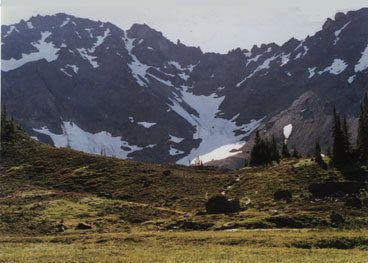
I took these two photographs in Royal Basin in the Northern Olympic range. It's a veritable garden spot, with wildflowers blooming everywhere across the meadows.  There are three levels in the basin. We hiked to the uppermost basin and camped here. The rocky outcroppings that you see in the photos are where you will find the rare Olympic endemic flowers that I mentioned above.

Would you like to see my other blog? It looks completely different than the Trowbridge blog. All of the work in my Bron Smith's Flights of Fantasy blog is my work. I wouldn't want to confuse my work with Mrs. T's beautiful watercolor journal pages.

Saturday, September 22, 2012

Getting Ready for Winter


Fall is now here, and the winter snows will soon be upon us. It seems the summer season was much too short.

Were it not for their lupine seed oil lamps, Mrs. Trowbridge and the citizens of Huckleberry Hollow would have endured the harsh winters in utter darkness. They carried on their busy lives under a deep blanket of snow, traveling about by way of crooked, winding tunnels. All of her winter journal entries, such as the one above, were scribed and painted by candlelight or oil lamp during the long winter months. The small creatures used lupine seed oil  because lupine flowers were plentiful and easy to find. One of their primary late summer tasks was harvesting lupine seeds and crushing them to extract the oil, enough to last all winter long.


Tuesday, August 14, 2012

MONSTERS, MYTHS, LORE AND LEGENDS


Many of Mrs. Trowbridge's pages were devoted to the legends and lore of the rain forest. Many of her paintings of monsters and legends are freeze-framed in my memory.

As you can see from the text in Mrs.Trowbridge's journal page, she was very nervous about sketching a Log Ogre's den en plein air, so she very quickly laid out her subject with her fir needle charcoal stick, then returned to her studio cottage to apply the color. She was able to use her expert knowledge of the forest and its hues to apply the colors from memory. The fern on top of the nurse log is a Deer fern (Blechnum splicant). The white plant to the right of the log is an Indian Pipe (Monotropa uniflora), and the yellow flowers growing on the moss are the Western buttercup (Ranuncula occidentalis).

Have you seen my other blog, Bron Smith's Flights of Fantasy?